
Wire-Brushed White Oak Floors for Sunny Great Rooms in Boise
Sunlight is the hardest test a hardwood floor faces, and the photo below is a floor passing it.
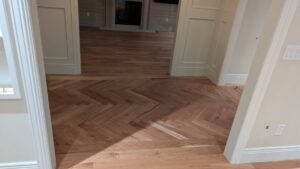
Why is sunlight a hard test for hardwood? Because it works on a floor in three ways at once, and it does so every day:
- Light coming in at a low angle picks out every speck of dust and every small scratch that softer light hides.
- Any shine in the finish throws that light straight back at you as glare.
- The ultraviolet part of sunlight slowly changes the color of both the wood and the finish on top of it, so a floor that looked right on the first day can drift over a few years.
The boards in the photo above are white oak from a recent installation of ours, and you can see more of our projects on our Instagram page. The light coming through the doorway in the picture shows you the herringbone pattern and the grain of the wood clearly. A smooth, glossy wood floor in the same spot would do the opposite – on a sunny day it would throw that light straight back at you.
Whether a wood floor glares in the sun comes down to three choices:
- The kind of wood and its color.
- The texture of its surface.
- How much shine is in the finish.
The floor in the photo is pale white oak with a brushed surface and a low-sheen finish, which is why the light lands on it and stays there. A dark board with a smooth face and a glossy finish would send the same light straight back up. The rest of this post is about getting those three choices right in your own room.
What “wire-brushed” means
If you look closely at an oak board you can see the grain as alternating bands. Every year the tree adds one lighter band of softer wood in spring and one darker band of harder wood in summer, and those bands are what give oak its pattern.
Wire-brushing happens at the factory before the finish goes on. Stiff steel brushes are run along the length of each board, and they wear away a little of the softer bands while the harder bands stay put. What is left is a surface with a faint texture you can feel with your fingertips, made of shallow grooves that follow the grain of the wood.
That texture is what makes the floor work in a bright room. When sunlight comes through a window at a low angle, a smooth floor acts like a shallow mirror and throws the light back up at you, while a brushed surface breaks that reflection into many small ones, so you see the wood and not the window.
The texture also hides wear. Dust, pet hair and the small scratches that come with daily life settle down inside the grooves instead of lying on top of a flat surface, so they stop catching the light. A wire-brushed white oak floor still scratches like any other oak floor, and a hard knock will still leave a dent, but most of the small marks disappear into the grain instead of standing out on the surface.
How much texture you get depends on how hard the mill brushed the boards. A light brushing gives a subtle grain you mostly notice when the sun is on it, and that is what we recommend for a clean, modern room. A heavier brushing holds more dust in its grooves and gives the floor a rougher, more rustic look. Mills usually pair that heavier brushing with boards that keep their knots and color streaks, which is sold as character-grade hardwood, because both choices push the floor in the same rustic direction.
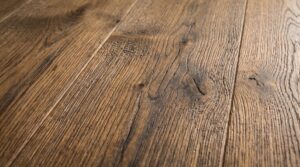
That look suits a lodge-style home better than a bright, clean-lined one. Wire-brushing is also easy to confuse with two other textures you will see on sample boards. Hand-scraping leaves long, shallow scoops across the width of each board, and distressing adds dents, wormholes and other marks of age. Wire Brushing does neither. It only brings out the grain that is already in the wood, which is one reason it suits a bright, open room.
Why white oak, and why a natural finish
Red oak and white oak are the two oaks most hardwood floors are made from, and they do not look alike once the sun is on them. Red oak has a pink tint that warms toward orange in strong light. White oak is a soft tan with a little gray in it, and it holds that color in a bright room instead of shifting warmer as the day goes on. White oak is also the harder of the two.
The flooring industry rates hardness with the Janka test, which involves pressing a small steel ball halfway into a sample board and records how much force that takes. White oak needs about ten percent more force to push the ball in than red oak does.
In practice that means it stands up a little better to everyday wear. Our white oak vs. red oak guide goes through the other differences, including how each one takes stain.
White oak has one more advantage that comes from inside the wood. Its pores are partly blocked by tiny natural growths called tyloses, which seal the channels that would otherwise let liquid pass through the wood. That is the reason barrel makers use white oak for wine and whiskey barrels: a white oak barrel holds liquid, while red oak, whose pores are open, would weep. On a floor those sealed pores mean a spill sits on the surface longer before it soaks in, and the wood takes a clear finish evenly.
A “natural” finish means no stain at all. The board gets a clear protective coat, and the color you see is the oak’s own. That makes the finish itself the main thing deciding how the floor looks in ten years, so it is worth understanding what the two main types do.
An oil-based polyurethane finish is made with natural oils, and those oils react slowly with air and light. They will gradually take on an amber tint as they cure and most often will keep curing over the years. On a dark floor that extra warmth looks fine. On a pale floor it shows as yellowing, and sunlight speeds it up.
A water-based finish, and the factory-cured finish on most prefinished boards, contains none of those oils, so it dries clear and stays close to clear. The wood underneath will still mellow a shade warmer over its first year or two, which is normal for any oak, but the yellow cast people complain about on a light floor is almost always the finish.
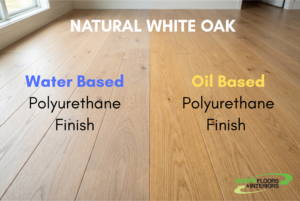
Natural is one of three pale looks you will see on the sample wall. A white-washed board has white pigment worked into the grain, which gives a very light Scandinavian look but shows dust and can look chalky in strong sun. A greige stain adds a little gray and beige to tone down warm light, and it can look flat in dull light. A natural finish sits between those two. It keeps the room bright and still looks like wood when the light is low.
In our showrooms, a good place to start is the Shaw Inspirations White Oak in Natural, which is a wire-brushed engineered white oak on 7-inch-wide boards with a water-resistant factory finish. Take a sample to a window before you decide, because showroom lighting and daylight show a pale floor differently.
What the sun does to the floor, and what to do about it
Sunlight reaches a floor differently through the year. In winter the sun stays low in the sky, so it comes through the windows at a shallow angle and reaches well into the room. In summer it is high overhead, and the light lands closer to the glass. A floor in a bright room gets both, and the changes that follow are ones you can plan for.
The most noticeable change is color. Every wood species shifts a little in daylight, and white oak mellows slightly warmer over its first year or two. The finish decides whether that shift stays subtle or turns yellow, which is why we pointed you toward a water-based or factory-cured finish above.
The one thing to expect is that the change is uneven. The floor under area rugs keeps its original color while the floor around it mellows, so if a rug comes up after a year or two there will be a lighter patch where it sat. The patch catches up once it is exposed to the same light, and a brushed, matte floor hides the difference far better than a smooth, glossy one would.
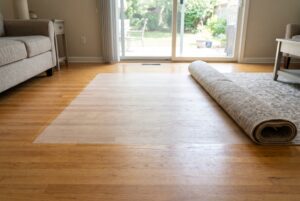
Winter adds glare. Snow reflects a great deal of ultraviolet light, which is the part of sunlight that fades color, so while there is snow on the ground the floor nearest the windows gets more UV than at any other time of year and ages faster than the rest of the room. A rug or runner in that spot through the winter protects it and catches tracked-in grit at the same time.
Your windows help more than you might think. Most windows sold in the last fifteen years have a low-E coating, which is a very thin, invisible layer of metal on the glass that reflects heat and blocks most of the ultraviolet light that fades floors and furniture. If your windows are newer than that, they are already doing most of the work. A sheer or a shade on the sunniest window during the brightest part of the day handles the rest. Our guide to hardwood in sunny Idaho rooms covers which species and finishes fade the least.
Texture and sheen help here too. On a smooth, glossy floor, a patch that has mellowed in the sun shows as a distinct shape with a visible edge. On a brushed, matte floor the texture breaks that edge up, so the same amount of change is much harder to see.
Choosing the boards
Width is the first decision, and it comes down to seams. Every joint between boards is a line, and in a big room full of light those lines are what the eye picks up. The narrower the boards, the more of those lines there are, which is why a traditional strip floor can look busy in a large room. Wider boards mean fewer lines and a calmer floor, and for most big open rooms we recommend boards around 7 inches wide, going wider when the ceiling is high or the room is unusually long.
There is a trade-off, however.
Wood swells and shrinks across its width as the air in the house gets damper or drier, so a wider board moves more between summer and winter. For that reason we usually steer wide-plank jobs in this valley toward engineered boards. Solid white oak is still a good choice at moderate widths. We stock solid natural white oak in 5-inch boards, and it does well in a home that runs a humidifier through the winter.
Length matters as much as width and gets far less attention. Every place one board ends and the next begins is a small joint that throws a shadow when the light comes in low, so a floor made of short pieces looks patchy in a sunny room. Ask what lengths come in the box. Boxes with a good share of long boards make a noticeably smoother-looking floor than boxes that are mostly short pieces.
While width and length decide how many lines you see across the floor, Grade decides how much variation you see within the wood boards themselves. When a mill sorts its boards, it grades them by how many knots, streaks and color changes it lets through. A select grade has small knots and a narrow range of tan, while a character grade has open knots, dark streaks and a wide color range. For a bright, clean-lined room we recommend select or a light character grade. A natural finish shows the grade as it is, since there is no stain to blend the boards together.
Sheen is where a lot of people get surprised, so it is worth knowing how it is measured. Finish makers measure it with a gloss meter – which is a handheld instrument that shines a light at the floor at a set angle and records how much of that light bounces straight back, and the result is called a gloss reading on a scale from 0 to 100. A mirror would score near 100 and a chalkboard near 0. Floors sold as matte generally score in the low 20s or below, satin lands roughly in the 30s and 40s, and semi-gloss sits above 50, though every maker draws those lines a little differently. In a sunny room that reading decides whether you see a floor or a reflection of the window.
A high-gloss floor returns the sun straight to your eyes, while a matte floor scatters it, and matte also hides the scuffs and footprints that a shinier finish would show. We recommend the lowest sheen the maker offers for any floor that gets direct sun.
The last choice is which way the boards run. In a sunny room, run them toward the main window, so the light travels along the length of each board. Light that crosses the boards hits every joint between them and turns each joint into a thin shadow line, while light running along the boards leaves the joints almost invisible.
Most big rooms look best with every board running the same way toward the light, but a pattern in one area can do a job too. A herringbone or chevron section at the entry or under the dining table sets off part of a large open floor without switching to a different material, and the herringbone meeting straight boards in the photo at the top of this post is an example of it. Our guide to hardwood layouts shows how the common patterns look in a room. The aim either way is a floor where the light shows the wood rather than the seams.
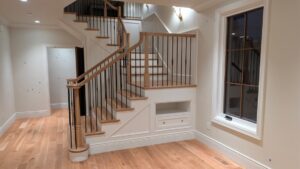
The room below is from another installation of ours, and it shows most of these choices at once. Wide natural white oak boards run the length of a bright room and up the stairs, and the dark window frames and white trim keep the pale floor from looking washed out.
Is solid or engineered hardwood better for a Boise winter?
Wood takes in moisture from the air and gives it back, and it swells and shrinks a little as it does. How much moisture the air is holding is called relative humidity, which is given as a percentage of the most the air could hold at that temperature.
Wood floors do best when the relative humidity indoors stays somewhere between 30 and 50 percent.
Summer in the Treasure Valley sits in that range on its own. Winter does not, because cold outside air holds very little moisture to begin with and a furnace running all day dries the air in the house further. Without something adding moisture back, a Treasure Valley home in the middle of winter often sits well below 30 percent relative humidity, which is dry enough to make a wood floor shrink and open small gaps between the boards.
That is the background to the solid or engineered question. A solid board is a single piece of wood from top to bottom, and because there is nothing but oak under the surface it can be sanded and refinished several times over a very long life. In narrow widths it handles our winters well as long as the house is kept from getting too dry. The wider the board, the more it moves, so wide solid planks in a dry house open noticeable gaps every winter and close them again every summer.
An engineered board has a layer of real hardwood on top, white oak in this case, glued to a base made of several thinner layers of wood running in alternating directions. Those crossed layers hold the top layer steady, so an engineered board moves far less with the seasons. That stability is the main reason engineered hardwood is our usual recommendation for wide planks in Idaho’s dry climate.
Engineered boards are not immune to dry air, however. If a home is kept very dry for months on end, the layers can dry at different rates and the top can cup or separate. It is worth knowing that flooring makers usually do not cover that damage under warranty because the home was outside the humidity range they specify.
The fix is the same for solid and engineered floors. Put a whole-house humidifier on the furnace and set it to hold the air somewhere around 35 to 45 percent relative humidity through the winter, and keep an inexpensive humidity gauge nearby so you can see that it is doing its job.
With the air kept in that range, an engineered wide-plank floor is the most stable hardwood we can sell you.
For a wire-brushed engineered white oak in our catalog, look at the Hallmark Alta Vista collection, which is a hand-brushed European white oak on 7 1/2-inch boards with a top layer of oak thick enough to be sanded and refinished later on.
Before the first board goes down
Hardwood needs to settle into the house before it goes down. The boards should arrive after the heating system is running and the drywall and paint are dry, and they should sit in the room for several days so the wood can adjust to the moisture level it is going to live with.
A good installer checks both the boards and the subfloor with a moisture meter before starting, and wide planks deserve a stricter check than narrow ones because they have more room to move. How long the settling takes depends on the season and the house, and acclimating hardwood to Idaho’s climate usually runs longer in winter than people expect.
The floor underneath has to be flat. Wide boards show every hump and dip in the subfloor, so high spots usually need grinding down and low spots filling before any wood goes in. Our hardwood installation page has a short checklist of what needs to happen before installation day, including subfloor repairs and clearing the rooms.
How the floor is fastened depends on what the house is built on. On a concrete slab there are two choices. The boards can be glued straight to the slab with an adhesive made for the job, which also seals out moisture coming up through the concrete, or the floor can be floated, which means the boards click together into one large sheet that rests on a thin foam pad and is not fastened to the slab at all. Over a wood subfloor with a crawlspace underneath, the boards are usually nailed down, sometimes with glue as well.
The differences between floating, nailing and gluing a hardwood floor matter most for stairs, radiant heat and wide planks, and they are worth asking about before the job is quoted.
A wood floor also needs a little room to move at its edges. A small gap is left at the walls and along any exterior door track and hidden under the baseboard and the door’s threshold, so the floor can expand in summer without buckling. Where the hardwood meets tile at the kitchen or the entry, the transition between the two floors should sit flush so there is nothing to catch a toe. If the job falls in winter, the furnace needs to be running for several days before installation, because flooring adhesives and finishes have minimum working temperatures.
Fitting the floor to the rest of the room
A natural white oak floor is a middle tone, lighter than most furniture and darker than most walls, and that is why it works under so many different rooms. Against a stone fireplace, the brushed texture of the wood has enough character of its own to sit beside rough stone without competing with it, and a pale floor keeps a room with heavy beams or dark stone from feeling dark and closed in.
In an open kitchen, natural white oak works under white, green, navy and black cabinets alike. If the cabinets are white oak too, keep the floor a shade lighter than the cabinets and run the boards the opposite way to the cabinet grain, and the two will look planned.
For countertops, a matte or lightly textured quartz or quartzite keeps the low-sheen feel of the floor going, while a highly polished surface in a sunny room becomes one more thing throwing light around.
Wall color trips up more people than anything else. Natural white oak has a touch of gray in its tan, so it looks best with warm whites that carry a little gray themselves, and with soft greens and clay tones. Very cool, pure whites can look blue next to it in strong light, and yellow-based creams pull the floor toward orange.
White trim and dark window frames both suit it. For rugs, a low-pile wool rug with some pattern softens a large expanse of floor and takes the sun in place of the wood, and a breathable rug pad underneath lets the floor keep aging evenly.
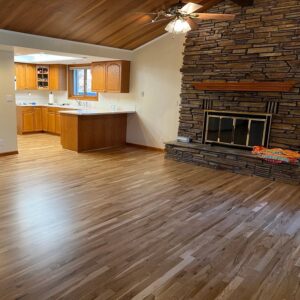
The room below, another floor from our hardwood gallery, puts most of that together. Solid white oak with a natural finish runs from a stacked-stone fireplace through to a kitchen with wood cabinets, and the floor is pale enough to lift the room and warm enough to sit beside the stone and the wood ceiling.
Keeping it looking new
A brushed floor hides dust well, but it also holds some of it down in the grooves, so the cleaning routine is a little different from a smooth floor.
A vacuum with a soft floor head does a better job than a broom, because a broom pushes grit along the grain while a vacuum lifts it out, and in the dusty months it is worth vacuuming twice a week.
For washing, a barely damp microfiber mop and a cleaner made for finished wood floors is all the floor needs.
Vinegar, oil soaps and steam mops all do harm over time, and anything that promises shine leaves a film on a matte floor that eventually has to be stripped off.
Felt pads under any furniture that gets moved, and a mat at the door you use most, take care of most of the rest. Our hardwood care page has the full routine.
When the finish starts to look tired in the traffic paths after some years, the first step is a recoat rather than a refinish. A recoat means lightly scuffing the old finish and applying a fresh top coat over it, which brings the floor back without touching the wood.
A full sanding would take the brushed texture off along with the old finish, so the usual approach on a brushed floor is to recoat for as long as possible and save sanding for a floor that is truly worn through. Knowing the difference between a floor that needs refinishing and one that needs replacing saves a lot of guesswork later on.
If real hardwood is more than the budget allows
The wire-brushed white oak look is now available in vinyl and laminate as well. A good luxury vinyl plank carries a printed image of natural white oak with the brushed grain pressed into the surface so that the texture you feel lines up with the grain you see, over a waterproof core that does not shrink or swell with dry winter air.
The COREtec lines we carry are built that way, and the newer laminate floors take the same approach on a dense wood-fiber core. You give up the depth real wood has in daylight, the option to refinish and some resale value, and in return you get a lower price, no seasonal gaps and a surface that stands up to pet claws better than any wood.
Our showrooms have full displays of both, so you can compare them under the same light.
Plan your floor with Nampa Floors & Interiors
Our family has been helping Treasure Valley homeowners choose floors since 1954. Visit the Nampa Super Store at 2121 E Plaza Loop, the State Street showroom in North Boise or the Maple Grove showroom in South Boise and take a few wire-brushed white oak samples over to the window. Or schedule your free in-home measure and estimate and we will measure the space and put together a quote for the floor and the installation.
Get Quote
Fill out the form and we will email your coupon
"*" indicates required fields