
Patio Doors to Mudrooms: Textured Porcelain Tile for Canyon County and Foothills Traffic
In 2023, 341 Idahoans aged 65 and older died from a fall. That works out to 100 deaths for every 100,000 older adults in the state, about 43 percent higher than the national rate in America.
A fall needs poor footing, and few things give poorer footing than a smooth floor with water on it. In a Treasure Valley home, the floor that gets wet most often is usually the one just inside the back door. Snow comes off boots there, wet dogs come in there, and all through irrigation season that is where mud from the yard lands first. A smooth tile in that spot is slick whenever it is wet, and a floor that soaks up water can stain and start to smell. Textured porcelain tile solves both problems at once, which is why we recommend it for patio doors and mudrooms more often than any other floor we sell. Picking the right one means reading the label, knowing what your own yard tracks in, and getting the work under the tile right, and the rest of this post walks through each.
What “textured porcelain” means on a tile label
Porcelain is ceramic tile made from a finer clay and fired at a higher temperature, and the result is a tile so dense that water barely gets into it. That density is the whole reason it works at a back door. Melted snow and muddy water sit on the surface until you wipe them up instead of soaking in, and the same density lets the tile run out onto a covered patio and sit through an Idaho winter without flaking apart when it freezes.
The word “textured” describes the surface, not the tile underneath. Most textured floor tile is porcelain with a matte glaze that has a fine grain pressed into it, and that grain has one job, which is to give a wet sole something to hold on to. When you shop for a patio door or mudroom floor, that grip is the thing you are buying, and the color and pattern come second.
Tile makers measure that grip with a slip rating called DCOF, short for dynamic coefficient of friction. The rating is easiest to understand as a heavy box being pushed across a wet floor. The more the floor grips, the harder you have to push to keep the box moving, and DCOF turns that into a number. On a floor rated 0.42, keeping a 100-pound box sliding takes a 42-pound push. On a floor rated 0.55, it takes a 55-pound push. Swap the box for a wet boot and that is what the test measures: the higher the number, the better the grip.
The standard behind the rating, ANSI A326.3, groups floors by how wet they get. Kitchens, bathrooms and entries are classified as interior floors that get wet, and the standard sets 0.42 as the least grip allowed on them. Shower floors are held to a higher mark of 0.50, because people stand on them barefoot and wet. Outdoor patios and walkways are held higher still, at 0.55, because rain and snow land on them. A polished, glossy tile loses most of its grip once it is wet, and many test below 0.42. For a mudroom or a patio door, we treat 0.42 as the minimum and prefer 0.50 or better, because wet boots and wet paws are the daily condition there, not the exception. Even so, no rating makes a floor slip-proof, and the standard says as much, so mats and quick cleanup still matter.
Texture tells you about grip. One more label on the sample board, the PEI rating, tells you about wear. It is a scale from 1 to 5 that measures how well the glaze stands up to scuffing and wearing through under foot traffic: a 1 belongs on a wall, and a 5 can handle a store floor. For an entry or mudroom, look for a 4 or a 5.
What Canyon County yards and foothills trails bring inside
Most of what lands on a back-door floor in this valley comes straight from the yard. Nampa, Caldwell and Middleton sit on fine, silty soil that turns to sticky mud when it is wet and to flour-fine dust when it dries, and it is wet for a long stretch of the year. Most subdivisions in Nampa and Meridian water their lawns with pressurized irrigation from the canals. That water turns on in the middle of April and shuts off in early October, so a wet dog run or garden bed can feed mud into the house for half the year. The dust of late summer then follows the mud in and settles into the grout lines.
Homes closer to the Boise Foothills bring in something different. The trails up there are sandy in some places and clay in others, and the two travel home in different ways. Sand rides in on boot soles and scratches a softer floor the way sandpaper would, while clay packs into the treads and lets go on the first dry floor it meets, which is usually the one inside the back door. A porcelain glaze stands up to that sand where a wood finish or a vinyl wear layer would scratch, and the clay usually sits on top of the texture until a broom reaches it.
Winter adds slush, and with it whatever the road crews put down to fight ice. Boise gets snow on about 18 days in a typical winter, most of them between November and February. Before most of those storms, the highway and county crews spread salt and spray magnesium chloride, a liquid de-icer, so ice cannot bond to the pavement. Both leave a white, slightly greasy film that rides home on boots and tires. On a hardwood entryway that film can dull the finish over time. On porcelain it comes off with a damp mop, because the salt never soaks in.
Patio doors and back entries
A sliding patio door collects everything from the yard onto one narrow strip of floor. Coats drip at the door track, a wet dog shakes off in the same spot, and whatever is on the bottom of a shoe comes off in the first few steps. On a smooth floor that strip stays slick for a while after rain, and on a wood or vinyl floor it is usually the first place to wear and stain.
We treat that strip as its own floor. Just inside the door we usually lay a band of textured porcelain and let the room’s hardwood or luxury vinyl plank begin beyond it. The band runs a few feet into the room, far enough to catch what comes off boots on the way in. The tile catches the water and mud where they fall, so the softer floor stays dry, and a mid-tone tile with some variation in its color hides the dust between sweepings. A matte finish matters too at a door that catches the afternoon sun, because low light through the glass glares off a glossy tile.
If the same tile will carry on outside to a covered patio, pick it for the harder of the two jobs.
Outdoor tile needs the outdoor slip rating of 0.55 or better, and it needs a frost rating, which means the maker has frozen and thawed it in testing without it cracking. The patio slab and the floor inside the house expand and shrink by different amounts between summer and winter, so at the threshold we usually leave a soft, caulked joint instead of a hard grout line. That joint absorbs the movement and keeps the tile from cracking, and a flush transition to the floor inside means there is no lip at the doorway to catch a toe.
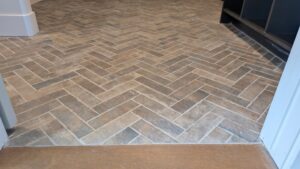
The entry below is from a project we shared on Instagram in September, and it shows the hand-off we have just described. Brick-look porcelain laid in a herringbone pattern takes the traffic inside the door, and the hardwood begins where the tile ends, with a flush seam between the two.
Mudrooms and laundry rooms
A mudroom floor gets the worst of everything above, and when the washer shares the room there is always the chance of a leak on top of it. Porcelain takes standing water and dried mud without either leaving a mark, which is why it is our first choice for the room.
We build most of the mudroom floors we install in Nampa and Boise the same way.
- We use tile 12 by 24 inches or larger, because bigger tiles mean fewer grout lines to scrub, and a small room looks calmer with fewer joints running across it.
- We choose a matte, textured glaze in a mid-tone color with some variation, and we steer people toward a fine, sandy texture rather than a deep one. Mud dries in deep grooves and needs a brush to come out, while a fine grain still grips a wet boot and sweeps clean.
- We grout with epoxy grout in charcoal, taupe or warm gray. Epoxy grout does not absorb water, resists stains and never needs sealing, so it earns back its higher price in a room that gets this wet. Our guide to choosing grout colorwalks through the shades.
- We run the tile up the wall behind the bench and under the coat hooks, either as a tile baseboard or as a half-wall, so drips from wet coats land on tile instead of drywall.
- We often add an electric heating mat under the tile. A tile floor is only as warm as the room around it, and a warm floor dries boots and paws faster as well as feeling better in January.
Add a bench, a boot tray and, where the plumbing allows, a dog-wash station, and far less of the mess makes it into the rest of the house. Our earlier post on designing an Idaho mudroom goes further into the gear side of the room.
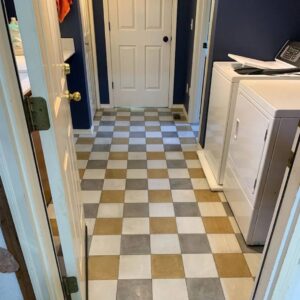
The laundry and back hall below, one of the floors in our tile gallery, shows what a pattern can do in a room like this. The checkerboard of white, gray and tan squares breaks up the floor so tracked-in silt disappears between sweepings, and the tile runs under the washer and dryer and right up to the door at the far end, so a leak or a dripping coat lands on porcelain and nothing else.
Choosing a texture you can still keep clean
More grip usually means more work with a mop, so the texture to choose is the one that stops a slip without trapping dirt. For most patio doors and mudrooms that is a fine, sandy grain you feel under your hand more than you see, and it is the surface you will find on most porcelain that imitates concrete or stone. It grips a wet boot and still sweeps and mops like any other tile.
A deeper texture that copies split slate grips even better and hides everything, but dried clay settles into its low spots and needs a stiff brush now and then, so choose it only if you are happy to scrub. Wood-look planks can work at a door as well, as long as the grain is something you can feel, because some wood-look tiles are printed smooth and give very little grip. Whatever the look, skip polished and high-gloss glazes anywhere a wet boot lands. Those are the tiles the slip rating exists to warn you about.
Color does as much work as texture. A mid-tone gray, taupe or warm gray-beige with some variation in it hides the valley’s dust between cleanings, while a solid white or solid black floor shows the same dust almost as soon as it lands. Keep the grout close to the tile’s darker tones so the joints fade into the floor instead of drawing a grid across it.
Then bring your boots to the showroom. We will wet a sample so you can feel how your own sole grips the tile you are considering, which tells you more than any number on the label, and you can browse our tile collection online first to narrow the choice down.
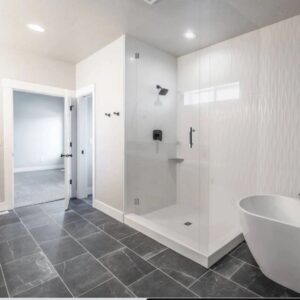
For a sense of what that balance looks like once it is installed, the bathroom below is from a Parade Home we tiled for Gingrich Homes this summer. The large-format porcelain is set on the diagonal in a light color with soft variation, and the joints are tight enough that there is very little grout to keep clean.

Installation details that decide how long the floor lasts
A porcelain floor lasts only as long as the work underneath it, so before any tile goes down in an entry or mudroom our tile installation crews take care of four things.
- They make the floor flat. Large tile turns any dip or hump in the floor beneath it into a raised edge you can feel underfoot, and older homes in Nampa and Boise rarely start out flat enough, so we usually pour a leveling compound over the slab or the plywood before the first tile goes down.
- They put a thin, flexible mat between the floor and the tile. Floors in this valley move with the seasons. A concrete slab expands in summer heat and shrinks in winter cold, and the wood framing under a crawlspace home swells in the damp months and shrinks once the furnace runs. Tile does not stretch with it, so the mat lets the floor shift underneath without the grout or the tile cracking, for the same reason we leave a soft joint at the patio threshold.
- They spread mortar under the whole tile. Big tile calls for a mortar made for it, spread on the floor and on the back of each tile, so there are no hollow spots that could crack under a heavy step.
- They match the grout to the room. Epoxy grout is the right choice for a mudroom, and a sealed cement grout is the budget option. Tile with factory-ground edges can be set with very thin grout lines, so a large-format floor looks like one surface and leaves less grout to keep clean.
If the work happens in winter, the subfloor and the mortar both have to be at the temperature the manufacturer calls for, which usually means running the furnace for several days before the crew arrives. Our post on cold subfloors and winter installation walks through that prep.
The doorway below, another floor from our tile gallery, shows what the first of those four steps buys you. Dark marble-look porcelain meets bedroom carpet at the threshold with no raised edge between them, because the floor underneath was flattened before the first tile went down.
How to keep a textured porcelain floor clean
Textured porcelain asks for little, and most of what it asks for is a broom. Grit is what dulls any floor, and on a textured tile it gathers in the low spots, so sweep or vacuum most days during irrigation season and snow season. For the wash, use warm water and a mild cleaner made for tile. Skip vinegar, because acid eats away at cement grout, and skip oil soaps, because the oil leaves a film that holds onto dirt. A microfiber flat mop handles a fine texture, while a deeper texture needs a soft deck brush and a rinse to lift dried clay out of the low spots. Cement grout needs resealing about once a year. Epoxy grout never does.
A coarse scraper mat outside the door, a boot tray inside it and a washable runner beyond that stop much of the dirt before it reaches the floor at all. Our tile care and maintenance page covers the rest of the house.
Questions we hear in the showroom
Is textured porcelain tile cold underfoot?
It is no colder than the room it sits in, but it feels cooler than carpet because it pulls heat out of a bare foot faster. An electric heating mat under the tile takes care of that and dries boots faster too.
Is a textured floor hard to keep clean?
Not if you choose the texture with cleaning in mind. A fine, sandy grain cleans like any other tile, while a deep slate texture needs a brush in its low spots now and then. Pick the amount of texture you are willing to maintain.
What slip rating do I need for a mudroom?
Look for a wet DCOF of 0.42 at the very least, which is the lowest rating allowed on an indoor floor that gets wet. We prefer 0.50 or higher at a patio door or mudroom, because wet boots are the everyday condition there.
Can the same tile run outside onto the patio?
Yes, if it is a frost-rated porcelain with an outdoor slip rating of 0.55 or better, the patio slab is sloped so water drains off it, and the installer uses outdoor-rated mortar and grout with a soft caulked joint at the threshold.
Porcelain or luxury vinyl plank for the mudroom?
Choose porcelain if you want the surest grip and a floor that standing water cannot hurt. Luxury vinyl plank is the better pick if you want a softer, warmer floor that runs unbroken into the kitchen. Many homes do both, with tile at the door and plank beyond it.
Plan your entry or mudroom tile with Nampa Floors & Interiors
Our family has helped Treasure Valley homeowners choose floors since 1954. Visit the Nampa Super Store at 2121 E Plaza Loop, the State Street showroom in North Boise or the Maple Grove showroom in South Boise and try the textured porcelain lines from Daltile, Florida Tile and Emser with your own boots. Or schedule your free in-home measure and estimate and we will bring the samples to your door, measure the space and put together one quote that covers the tile and the installation.
Related reads
- Designing an Idaho mudroom: tile durability for year-round gear
- Tile and installation for Boise’s North End and foothills
- Prepping your hardwood entryway for Idaho winter slush, mud and salt
- How to choose the color of your tile grout
Get Quote
Fill out the form and we will email your coupon
"*" indicates required fields